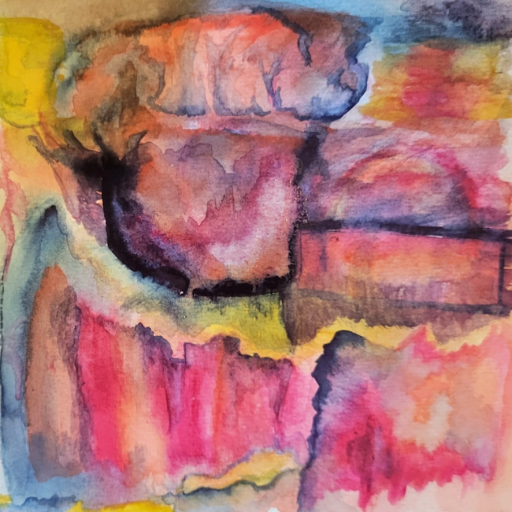
In Chinuk Wawa, an indigenous language of the Pacific Northwest, the word for green and the word for blue are the same: pchix̣ The teachers at the Confederated Tribes of Grand Ronde immersion preschool eventually had to create separate words: tipsu-pchix̣ (grass green-blue) and kusax̣-pchix̣ (sky green-blue).
This impreciseness confounded us learners, and we were grateful to the preschoolers who forced the new vocabulary. I live in the Willamette Valley: green trees, blue rivers. I could use a million words to describe the colors; surely the early speakers of Chinuk Wawa could, too?
But then I have a morning like today. My CBT-I doctor admonished me to get out of bed immediately upon waking, and go sit in front of a window so I could get that Vitamin D. It would help my circadian rhythm.
The sky today:
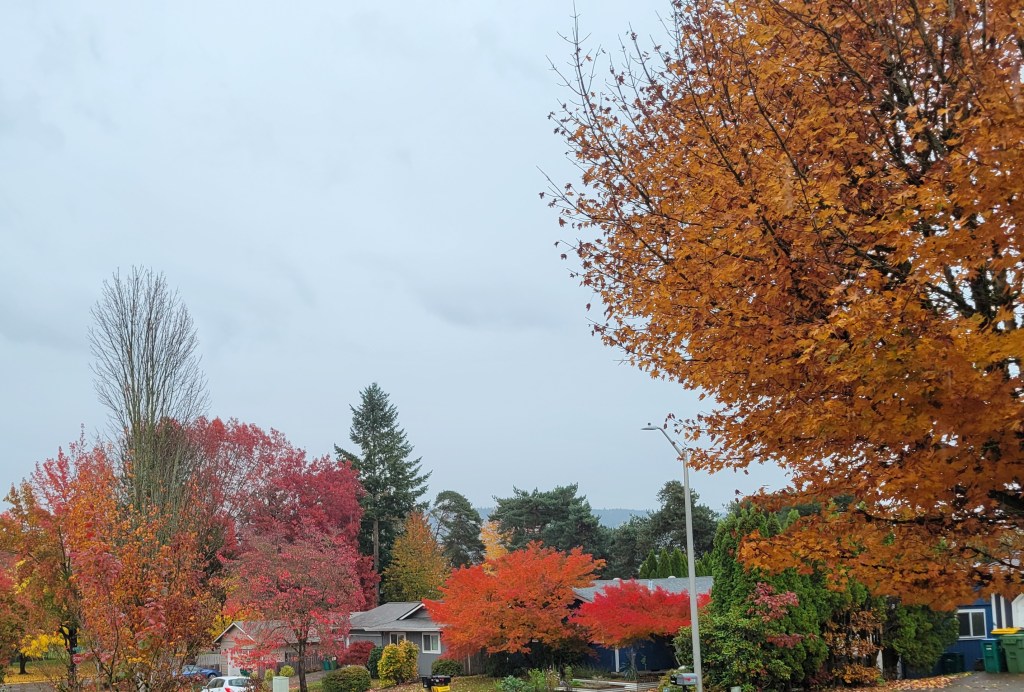
It’s all one color. Obviously the leaves are pʰil (red) and orange (samən-ulali t’wax̣, another word from the preschool). But the green leaves start to blend into the sky. The green rolling hill in the background looks like a darker gray of the sky.
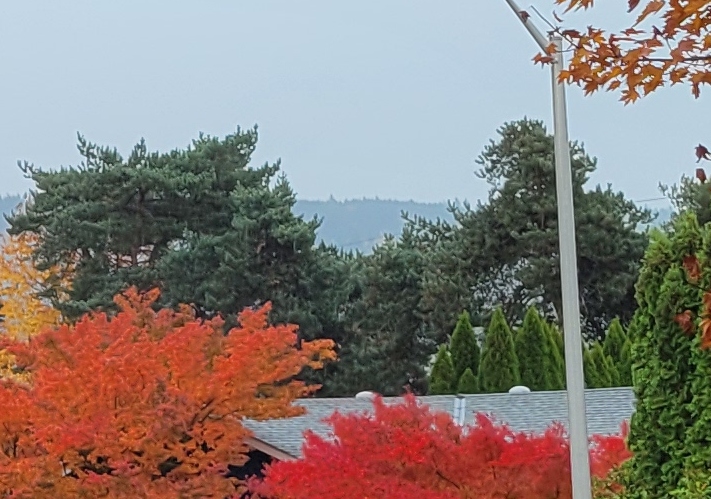
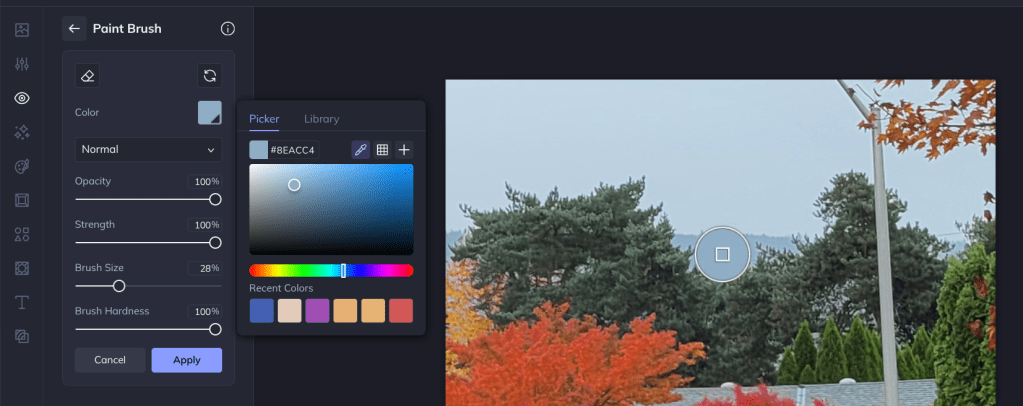
My photo editor reads it as light blue:
Many people in the PNW use light boxes. On their website, Verilux describes its light therapy lamps thus:
Verilux light therapy lamps mimic daylight by providing full-spectrum light without the harmful UV rays. Full spectrum, or natural light, provides important signals to the body to help you relax, focus, and feel revitalized. If you can’t get outdoors or there’s not enough natural light available, a HappyLight is a perfect choice to get your daily light intake.
Interestingly, my CBT-I doctor never recommended a sun lamp. All of our appointments were virtual, but he was based in a Portland hospital, so he knows what the weather is like. Even more interestingly-ier, in over 20 years of therapy and sleep complaints, no one has ever suggested I try such a lamp. I’ve only gotten the suggestion from (well-meaning!) friends.
While such treatment may benefit others, the data about light therapy and bipolar is………………………………mixed.
“One way of treating bipolar disorder is to manipulate the circadian rhythm. This can be achieved with bright light therapy, dark therapy, sleep deprivation, and certain types of psychotherapy.”
“Can Light Therapies Help with Bipolar Disorder?” Harvard Health Publishing
“There is positive but nonconclusive evidence that adjunctive light therapy reduces symptoms of bipolar depression and increases clinical response. Light therapy is well tolerated with no increased risk of affective switch.”
“Light Therapy for Patients With Bipolar Depression: Systematic Review and Meta-Analysis of Randomized Controlled Trials.” The Canadian Journal of Psychiatry
“The claim of “proven efficacy and safety” of early morning bright light treatment for bipolar depression is overstated. Many of the publications on morning light therapy and bipolar disorder in Dr. Benedetti’s review (3) included studies of seasonal depression and patients with both unipolar and bipolar disorder. Other studies were constrained by open trial design, lack of a comparator group, brief duration, inclusion of antidepressants with adjunctive light therapy, and light therapy combined with sleep deprivation. Assessing hypomanic or manic symptoms with a valid measure is necessary to quantify the rate of their emergence (4). Only 12 of 43 studies (3) included the administration of a mania scale, which will bias the results toward underestimating the occurrence of mixed states and hypomania.”
“Light Therapy and Risk of Hypomania, Mania, or Mixed State Emergence: Response to Benedetti et al.” American Journal of Psychiatry
I think my health professionals were trying to keep me from going crazier, which I appreciate.
 Bad Sleeper
Leave a comment